Siberian town rationed as river supply route failed
Residents of Tura face tripled prices and strict purchase limits after officials failed to secure land access when the Nizhnyaya Tuguska River became unnavigable.
By Cecilia Martin ·
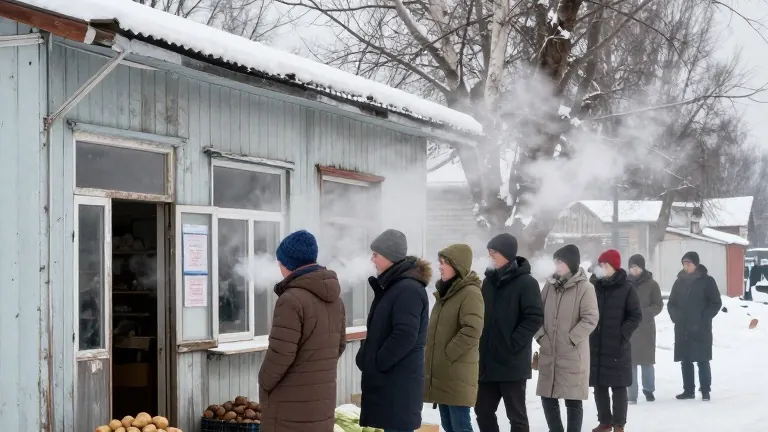
Residents of Tura, a remote Siberian town of 4,000 people, are currently rationing basic foodstuffs after a supply chain collapse left local shops nearly empty. The shortages emerged in mid-October when temperatures dropped to minus 15 Celsius and the primary water route from the regional capital became impassable. Local prosecutors have opened a criminal investigation into several officials suspected of negligence in managing the town's logistics.
The town’s isolation is structural. No road connects Tura to Krasnoyarsk, which lies more than 1,000 kilometers to the southwest. The Nizhnyaya Tuguska River serves as the main lifeline for transporting goods. In July, low water levels made the river unnavigable. Authorities did not establish a sufficient alternative supply route before the cold set in. As a result, fresh produce and other staples vanished from shelves by this month.
Official counts indicate that prices for remaining items have more than tripled. Svetlana, a resident who withheld her last name for safety, noted that cucumbers cost between 1,100 and 1,300 rubles per kilogram. Green onions sold for 1,800 rubles, and regular onions cost 1,000 rubles. Staff at the main food shop limited purchases to one kilogram per person. They required every family member to stand in line individually to receive their share. Svetlana described the scene as a return to Soviet-era rationing, with vendors refusing to let customers return later to finish their transactions.
Olga, another local, stated that her mother had to visit the store in person because staff would not allow a proxy to buy the elderly woman's allocation. Other families brought small children to the counters to claim rations for those who could not stand in line. The store clerk knew the size of the households but enforced the per-person rule strictly. Residents compared the current hardship to their memories of the Soviet period, with many saying the situation has become worse.
The crisis has intensified concerns about the approaching winter. The district administration reported on October 21 that food supplies at local schools would not last beyond the end of the month. Although air deliveries have begun, the most recent shipment arrived missing potatoes, onions, and cabbage after two flights were delayed by weather. Residents report that available food is being purchased quickly. When the river freezes, it can function as a road, but until then, the town relies on the air bridge.
The economic strain in Tura is compounded by the impact of Russia's war in Ukraine. The full-scale invasion, which began in February 2022, has claimed the lives of at least 34 men from the town. A March 2025 report by the Wilson Center noted that men from Russia's indigenous communities have been recruited at above-average rates and have suffered higher combat death rates. State incentives, including signing bonuses, have attracted local men to the front in a region with few other job opportunities.
Tura was originally an Evenk camp established in 1927. The Evenks are a traditionally nomadic reindeer herding group. About 900 of the town's residents have Evenk roots. President Vladimir Putin's government merged the Evenk Autonomous District into the Krasnoyarsk Krai in 2007. Residents say this administrative change contributed to a decline in support for indigenous cultures and local economies.
Kachikan, a Tura resident, stated that 20 to 25 Evenk men have gone to war over the past four years. He estimated that half of them have died. He named specific relatives, including cousins Timur and Romka Udygir, who were killed in action. Their ages at death were 30 and 42, respectively. Volodya Oyogir, the grandson of a prominent Evenk poet, was declared dead in 2026 after being missing since March 2025. The Mediazona database confirms these deaths among the 34 from Tura.
Vladimir, a local man, pointed to environmental factors that have reduced traditional food sources. He said oil spills in the Nizhnyaya Tuguska River in 2023 and 2024 killed most of the fish. The nearest reindeer herds are located in Surinda, a settlement approximately 400 kilometers away. He argued that the lack of government support and high prices drive people to join the military. The town currently waits for the river to freeze to restore ground-based supply lines.
Source: RFE/RL