Divers uncover 4,400-year-old trade goods near Kekova
Turkish officials announced the discovery of Bronze Age anchors and amphorae, suggesting early maritime routes connected the Mediterranean to the Jordan Valley.
By Josephine Clarke ·
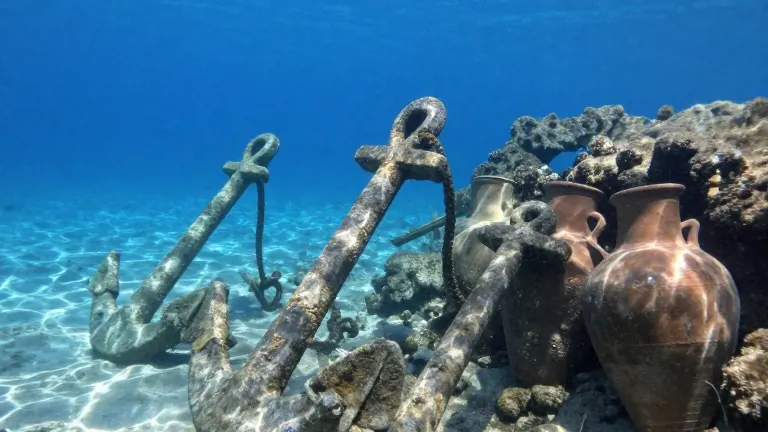
Turkish authorities confirmed the discovery of artifacts that may constitute the oldest known shipwreck in the world. The find was announced by Mehmet Ersoy, the minister of tourism and culture, on the social media platform X. The site is located off the coast of Kekova, a small, uninhabited island in the western Mediterranean Sea of Turkey.
The excavation team recovered three stone anchors and approximately 30 amphorae from the seabed. Dr. Hakan Öniz, an associate professor at Akdeniz University who led the Mediterranean Archaeology Association expedition, stated that the decoration techniques place the wreck in the Early Bronze Age. He noted that the dating is certain, describing the site as a time capsule at the bottom of the sea.
Radiocarbon dating suggests the amphorae are between 4,400 and 4,700 years old. This timeframe offers new evidence regarding ancient maritime trade along the Anatolian coast. Analysis of the vessel shapes indicates they were likely manufactured in workshops in the Jordan Valley. Similar artifacts have been found in Egypt, Troy, and Crete, pointing to a network of trade routes that spanned the region.
One specific amphora stands out for its unusual features. It bears nine distinct markings and has two holes in its body. Ersoy identified this vessel as unique among the recovered items. The presence of these modifications suggests it may have been repurposed, potentially serving as a churn for cheese or butter. This implies that Bronze Age sailors produced their own food during long voyages.
Dr. Karin Sowada, an archaeologist at Macquarie University, examined the interior of several jars. She reported finding a substantial amount of glossy residue that had survived for thousands of years. Sowada said the material could be olive oil, wine, or tree resins. She also noted that the jars were large and likely reused for many years after being emptied upon arrival at their destination.
Oniz described the emotional weight of the discovery, thinking of the sailors who loaded the amphorae and the families who waited for their return. Ersoy congratulated Oniz and the team members for their work in preserving underwater cultural heritage. The ministry stated the goal is to illuminate Anatolia's maritime history for future generations.
Source: The Jerusalem Post